Sabbatical 2012

Sally received a Fulbright Fellowship to teach and conduct research in Iceland for 5 months starting in January 2012. Luckily, Shan, Alex (age 12), Joslyn (age 9) and Spencer (age 5) can accompany her on this adventure. This blog will allow family and friends to keep up with the trials and tribulations of our escapades in Europe.

To enlarge photos, double click on them.


Saturday, April 28, 2012

Day 113-hiking Brekkuá and Rauðbrók

   April 26-The longwave upper atmospheric wind pattern that has led to the extended stretch of clear skies and cool temperatures is slowly evolving and pushing westward, leading to cloudier skies.  However, precipitation has held off thus far, so I decided to go on a small hike after teaching English at Hraunborg and having dinner with Sally.  The hike up the Brekkuá river with the gönguklúbbur the previous week had piqued my interest in this area, so I headed that way.  As I walked up the river, I noted that a path went into the crater of Rauðbrók, which is the westernmost of the three cinder cones on the north side of campus.  The center of the crater is a wonderland of small lava tubes and moss-carpeted lava.  Unfortunately, while wandering around in Rauðbrók, I blew out my hiking boot.  I have had these boots for 22 years, so I suppose this was bound to happen at some point, but they are my favorite, you know........
Grábrók, the largest and most famous of the cinder cones. "Grá" means gray.
Rauðbrók. "Rauð" means red.

Short lava tube, about two feet in diameter. 

Lava tubes form when lava hardens around a lava flow.  If all of the lava drains out, a hollow tube remains.  Lava on the ceiling may harden as it starts to drip down, forming these dropsteinn (stone drops).

Part of the Brekkuá flowing into ground.
    I continued back to the Brekkuá and followed it downstream into the lava that flowed out of Rauðbrók a few thousand years ago.  I had hoped to find the place that the river dives underground to flow under the Bifröst campus.  I only found one spot where the water demonstrably flows into the ground.  Otherwise, the river just shrinks in size over the course of a few hundred yards, until there is no river left!  All along the route, I kept running into small lava tubes, so it might be that the river slowly seeps through gravel on the river bed and into individual lava tubes until all the water is gone.  In any event, it was a fun little adventure.  There is something along the Brekkuá for anyone: hiking trails, pools for wading, and nice picnicking spots as well.  It will be a nice place to take the rest of the family when the weather warms up.
   The clouds finally brought precipitation this evening when we got a few short snow squalls.
While we have enjoyed and taken advantage of the dry weather these past couple of weeks, this is the kind of weather that seems to make more sense over here based on our short experience.  So, there was something comforting about the return of snow.

Day 112-chili

   April 25-The implosion of the Icelandic economy in 2008 sent schock waves through Iceland and left many of the locals feeling very glum.  In the immediate aftermath, a couple faculty members at Bifröst brought in soup to share with the rest of the employees here in the faculty/staff lounge.  Their only stipulation was that no one was allowed to discuss politics or economics, which was asking a lot at a school, whose focus is politics, economics, law, and business!
Sally thought this was an ingenious way to sell lettuce in
the grocery store.  You know it is fresh when you use it!
   The faculty and staff enjoyed the chance to socialize and decided to keep doing it.  So, a sign-up sheet is posted at the beginning of the fall semester, on which pairs sign up to supply soup for dinner every other Wednesday.  When we showed up in January, every time slot was taken, so we figured we would not have the chance to make soup for Sally's colleagues.  However, while sitting in the lounge earlier this week, it was noted that there was some confusion regarding the people who were signed up for soup for the next couple of weeks.  Sally had made chili dogs recently and discovered that chili is not commonly eaten over here, so she offered to make soup for today.  Of the two people who were signed up for today, Emma had already made soup with Pálmar two weeks ago, and Lára had forgotten, so they quickly took her up on the offer.
   So, Sally went shopping for the supplies she needed on Tuesday and did the initial cooking last night.  This morning, she put in more meat and beans and Shan carried the 15 liter pot over to the staff lounge so she could finish letting it cook on the stove there.  Around noon, we sent out an e-mail telling everyone that, "the grub was ready.  Come and get it."  (We figured we would go all-in with the Southwest theme.)  Sally did not make the chili very spicy, but she had some chili powder available to add to it.  She also provided some cheddar cheese and Ritz crackers, since she could not find any saltines over here.
   In short, the chili was a success!  Many people were very complimentary and a number of them asked for the recipe.  It was nice to finally find some American food that is not widely available or eaten over here, so we could feel like we were introducing them to something new!
   Shan got four posts up today.  He is on a roll now!

Friday, April 27, 2012

Day 111-school buses

   April 24-Today was a pretty typical Tuesday.  School, work, house-cleaning, and posts to this blog sum up most of the day for the Hays family.  Back in the States, we live a few miles
outside of Gunnison on a school bus route.  However, we drive the kids to school each day, since we have to go to town for our jobs as well.  Here, there is a bus route dedicated just to transporting kids between Bifröst and Varmaland.  However, that is not immediately obvious, because the buses are not painted or signed in any special way like they are in the States.
All busing services are contracted out here, which probably works out pretty well, since there are a large number of tour buses in Iceland that sit idle over the winter, which is the tourist off-season.  The contract for the girls' bus route is held by the father of Alex's friend, Imba.  The kids have really enjoyed being driven to and from school on these luxurious buses.  It might be a bit of a let-down if we start having them ride the school bus when we get back to Gunnison!
One of the school buses the kids have used leaves Bifröst on a recent morning.  The kids' school bags are stored in the luggage compartments for the drives to and from school, completing the "tour bus" feel.
This is the bus that the kids have ridden in most.  It is always left at Bifröst overnight.

Day 110-longer days and shorter nights

   April 23-Today was a pretty typical Monday.  School, work, laundry, and posts to this blog sum up most of the day for the Hays family.
Shan hiked Grábrók with the gönguklúbbur in the late afternoon.  This old rétt, or sheep pen, on the north side of the mountain has a lava canyon ingeniously incorporated into it on the right-hand side.
The girls finally finished their massive Easter eggs, whereas Spencer finished his Easter egg/soccer ball a week ago.  They used the bases as milk glasses to see if the result would be chocolate milk.  Not so much. 
   There was another aurora borealis show this evening.  It was rather weak, but we try to view them whenever we can, because we are never sure which show will be our last.  The length of nights around here are shrinking dramatically and the shallow path of the Sun at night means that it no longer gets completely dark.  This view to the
north shows twilight at 1am, when the Sun is on the opposite side of the Earth.  The aurora borealis is still visible, but just barely.
   The Sun now rises before 5am and sets after 9pm.  This has started causing sleep problems for us.  To combat this, Sally bought some black plastic bags and Shan used them to cover the edges of the windows to keep the light out that seeps in around the edges of the blinds.  It is not perfect, but it works well enough so the light no longer bothers our sleep.

Day 109-hiking Eldborg

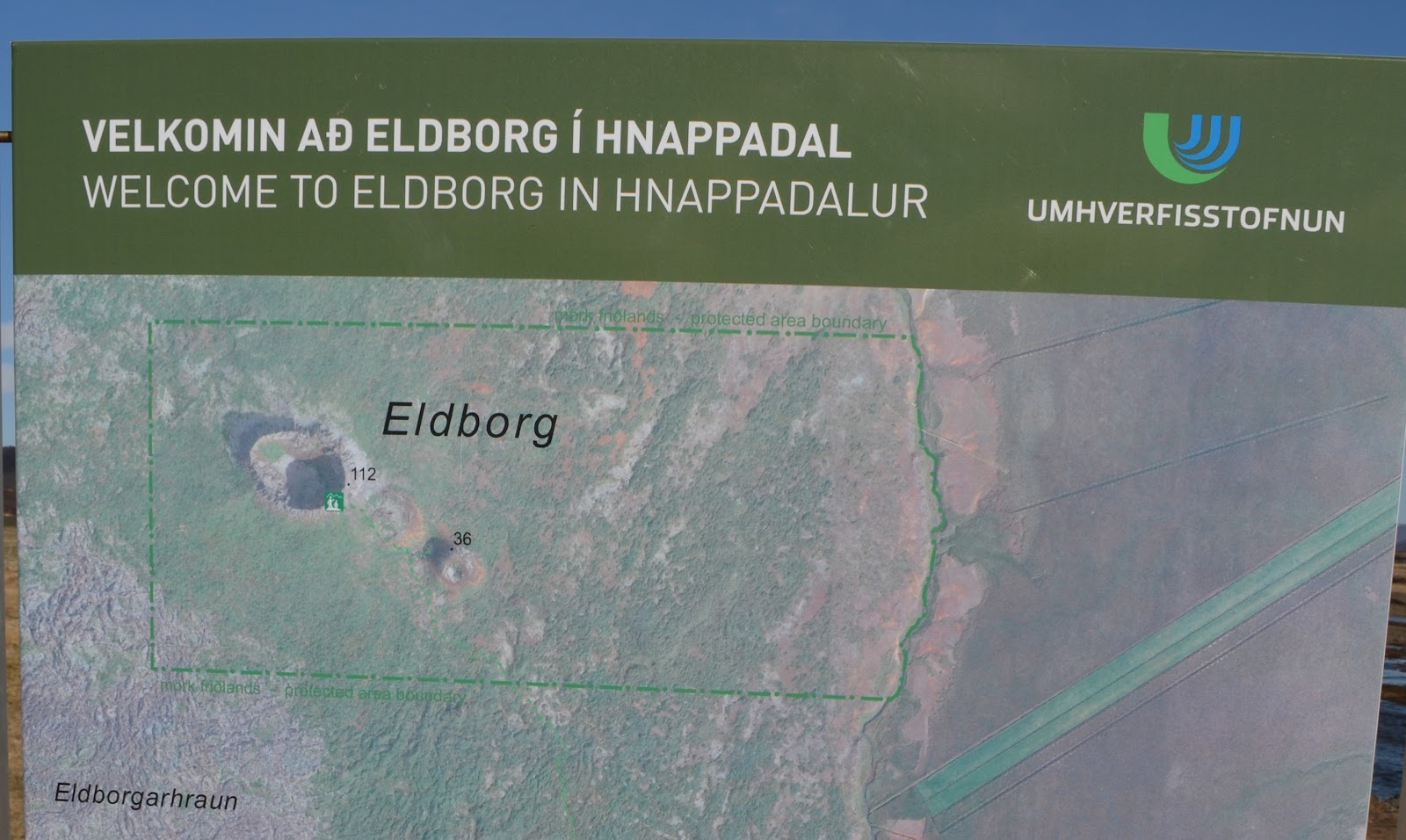
   April 22-Agreeable weather greeted us yet again this morning, so we decided to hike the Eldborg caldera, which lies in the southeastern section of the Snæfellsnes peninsula.  We drove out to the Snorrastaðir farm, where the farm's border collie came out to greet us and quickly adopted us.  She
tagged along as we started walking and ended up staying with us for the entire hike.  There was very little wind, the Sun was out, and the temperature was in the 40s, so the hike through the lava was quite enjoyable.  Eldborg (which means "fire cliff") was quite a sight with steep side walls surrounding a deep crater.  We followed the path up the side and took a short break along the top, before we headed back to the car.
Eldborg as seen from Snorrastaðir.
Eldborg from its rim with the mountains of Snæfellsnes behind it.
The rim of Eldborg.
The border collie joins us for a snack atop Eldborg.

A smaller cinder cone next to Eldborg and the mountains near Borgarnes off in the distance.
Descending Eldborg.
 
Playing in the smaller cinder cone.


The foals are out, much to the delight of our kids.

   We ate a short dinner back at the car and then drove north across the base of the Snæfellsnes peninsula to Hvammsfjörður.  After that, it was déjà vu all over again, as we repeated part of our trip from the previous Sunday.  We stopoped at the N1 gas station in Búðardalur for gas and a potty break and then headed for home.  Our second goal for the day was a return visit to the dairy Erpsstaðir so we could have some more of their tasty ice cream.  We ate the ice cream on the benches in front of the building and then drove on home.  Since we got home in the late afternoon, everyone had
time to wind down and relax before going to bed.  Shan even managed to get a few posts done for this blog, partially making up for the lack of posts the past couple of days.

Day 108-Egil's Saga

   April 21-We got home late the night before, so the kids got to bed late, and then the adults stayed up even later watching the aurora borealis, so everyone slept in today.  The day was clear again, so we figured we should not waste it sitting around the apartment and headed towards Borgarnes early in the afternoon.  Pulling onto the highway, the first thing we noticed was a plume of smoke rising to the south.  As befits our Colorado background, the first thing we thought was that there was a wildfire!  Then, we noticed that it was coming from the general direction of Varmaland, and we began to worry that the girls' school might be on fire.  In the end, it turned out to be a controlled burn of farmland.  This an old farming practice here, but it is now only allowed before May and more farmers are choosing to plow the previous year's growth under, rather than burn it. 
   After driving the country roads a while to find the fields being burned, we finally headed into Borgarnes.  Sally did some shopping and then we got started on the our primary intended activity for today: visiting the local sites that are associated with Egil's Saga.  This particular saga was written in the 13th century by a descendent of Egil named Snorri Sturluson.  Snorri was a powerful chieftain in the area and was quite knowledgeable of the region and his family's history, so it is deemed likely that the story is based on real people and historical events.  However, the stories Snorri wrote down had been passed down from generation to generation for over 200 years, so it is certain that inaccuracies had crept into them.
   The basic gist of the story is that this region, called Mýrar, was initially settled by Skallagrím Kveldúlfsson.  He and his father sailed from Norway in the initial wave of Icelandic settlement, but their ships became separated and his father died en route.  Before dying, he instructed his followers to throw his casket into the sea and to settle wherever it came ashore.  When the two groups made contact again, they searched for the casket and found it in the fjord near the present-day site of Borgarnes, so Skallagrím settled there.  Some time later, he had a son named Egil, whose adventures throughout northern Europe and the British Isles comprise a large part of the saga.  The saga finishes with stories detailing the dealings of his children with the descendants of Skallagrím's followers, who were given farms in the surrounding countryside.
The kids at Brákarsund with Borgarfjörður behind them.
   We had downloaded a tour onto the iPad that was produced by the Settlement Center in town and discusses the local sites that relate to the saga.  We started down by the Settlement Center, which sits at the end of spit, upon which Borgarnes lies.  The channel at the end of the spit is named Brákarsund, in honor of Egil's foster mother, Þorgerður Brák, whom Skallagrím killed here.  Skallagrím had flown into a fit of berserker rage while playing a version of ice hockey against Egil and his best friend.  He killed Egil's friend and was about to do in Egil as well, when Þorgerður stepped in and stopped him.  Skallagrím's rage could not be contained, however, and he pursued Þorgerður to this point and struck her with a rock as she tried to swim to the neighboring island.  The saga relates that, "neither the stone nor Þorgerður Brák where ever seen again."  The kids snickered mightily when the narrator of the tour called this story "beautiful."  Completing this story, the twelve-year old Egil killed the foreman of the farm before sitting down for supper with the family that night, in order to get back at his dad.  These sorts of stories are common in the sagas and provide an insight into the Viking mindset, at least as it was perceived by their descendants two centuries later.
   We drove into the center of Borgarnes, where Egil built a burial mound for Skallagrím when he died of old age.  Egil buried his favorite son in the same mound years later, after he drowned when his ship sank while sailing up the Hvitá river to gather wood.  The burial mound remained in existence for many centuries and was only destroyed in the 19th century, when the town of Borgarnes came into existence and residents started using stones from the mound to build homes and other structures.  Early in the 20th century a local women's group decided to recreate the burial mound and made it the centerpiece of a pleasant little park, which is named after Skallagrím.
   We next visited a site on the north end of Borgarnes, which was one of the twelve farms that were established by Skallagrím's followers when they settled Mýrar.  Most of the farms are still occupied and all are still called by the name that was given to them at the time of the Settlement.  Most of the names are "X's-place," where X is the name of the original settler.  This sounds quite amazing at first, but consider a similar situation closer to home.  When you listen to locals on the eastern plains of Colorado talk about farms, they essentially do the same thing ("We harvested the Akey place today.") even if the people the place is named after have not lived there or been associated with that farm for decades.  When you think about it like that, it becomes much less difficult to imagine farm names being passed down generation to generation virtually unchanged in Iceland.
Borg in front of mountains of the Snæfellsnes peninsula.
   We next checked out the views
from atop the Borgarnes water tank.  The standard issue viewing
dial allowed us to identify all of the interesting sites around us, including the farmsite of Borg, to which we went next.  Like most Icelandic words, "borg" has a multitude of meanings, but in this case, the farm was named after the borgs, or cliffs, behind it.  Given the ubiquity of cliffs in this country, we were a little surprised that these particular cliffs would be worthy enough to highlight with a placename.  In any event, "Borg" was the name that Skallagrím chose when he established his farm here.  It was subsequently passed down to Egil and Egil's descendants.  
From front to back, Borg, Borgarnes, Borgarfjörður,
(and Hafnarfjall), as seen from the "borgs" behind Borg.
   As the home of the leading men in the area for a few generations, Borg commanded a certain amount of respect and was a cultural center of Mýrar. Consequently, it was the location at which one of the first churches in Mýrar was built after the decision was made at the Alþing of 1000 AD that Iceland would convert to Christianity.  The current church is much newer, but it is almost certainly located on the spot where the first church was built, given the tradition of building new churches on the sites of old ones. 
   The cemetery has definitely not moved around in the intervening millennium, as is evidenced by one particular grave for a man who is mentioned in a "sequel" saga to Egil's Saga.  The narrator specifically pointed out that this grave is noteworthy for its north-south orientation, as opposed to the Christian tradition of east-west grave orientations.  As she noted, the decision to convert to Christianity was not accompanied by a great deal of liturgical education.  Since Icelanders were also largely illiterate at the time, they also could not read the contemporary Latin Bibles.  Consequently, they mostly were left to figure out this whole new religion on their own.  So, when Egil's grandson, Kjartan, was buried soon after the conversion, his uncle, Þorsteinn Egilsson, only knew that it was customary to bury the dead, but was ignorant of issues such as orientation, consecration, and the such.  This particular burial is all the more interesting,  because the runic headstone placed upon it 1000 years ago has survived.  By 1947, the ravages of time had broken it into thirds, so it was moved to the National Museum for safekeeping and a replica was put in its place.
   With our self-guided tour at an end, we headed for home.  We stopped briefly at the elf hill so the kids could finally have a chance to see some of the elf houses up close.  We have some rocks and hillocks on our property back in Gunnison that we think would be great homes for elves.  According to Icelandic folklore, all we need to do is make these locations inviting, so the kids want to build some houses and doors on our own elf hill when we get back home.
   We also finally took the time to stop at the Gljúfurá, which we have crossed countless times in our trips between Bifröst and Borgarnes.  The river's name, which means "canyon river," needs no explanation.  What we found most impressive about this river is the straight line that it follows.  Since lava tubes and lava gullies are often fairly straight, one possibility is that this is the source of the original channel that this river started following.  However, we are certainly not geologists and this explanation may not be correct.  Nonetheless, it is a striking canyon and river.
   We got back home before it was too late, so everyone was able to relax, play around outside, and even get some work done.  It was another nice, clear evening and there was a decent chance for more northern lights due to a coronal hole high speed stream becoming geoeffective, so we carried out our routine inspection of the night sky before going to bed.  Lo and behold, we got another light show.  The kids got up to look at it, but they were tired and maybe actually a little jaded by the aurora borealis at this point, so they headed back to bed rather quickly.  Meanwhile, the adults took pictures out the back door of the apartment and enjoyed the show until we hit the sack around midnight.

Thursday, April 26, 2012

Day 107-meeting the Ambassador

This was the first time we had ever been able to see
Snæfelljökull from Borgarnes.  It was an amazing sight!
   April 20-The kids missed the bus today.  Since they were not going to school, though, that was OK.  Instead, the whole family enjoyed a daytrip in Reykjavík today, because all of the Fulbright grantees (and their families) had been invited to to a reception at the U.S. Embassy.  The day was sunny and the views were the best we have ever had on a drive between Bifröst and Reykjavík.
We are standing in front of the Ambassador's residence.
   We drove down to Pam and Marilyn's apartment and parked there, because it was free to park in their driveway (and we are cheap) and because they live only a couple blocks from the Embassy.  We arrived at the Embassy at the appointed time (11 am) and were led through a side door into the Ambassador's residence.  A few Fulbright students also, the Icelandic Fulbright staff, and some of the Embassy staff also attended the event.  We had a nice time talking to everyone.  The U.S. Ambassador to Iceland, Luis Arreaga, has a Ph.D. in development economics, but he and Sally did not talk much about economics.  Mostly, they talked about Iceland and children.  The Ambassador's children are all grown, except one son, who will soon graduate from the International Baccalaureate program in Reykjavík.  Since he is a career diplomat (not a political appointee), Dr. Arreaga has seen a number of capital cities and he feels that Reykjavík is the safest of them.  He even allowed his youngest son to take his granddaughter around the city when she visited over Christmas. 
   Our kids, the only ones at the reception, behaved remarkably well at the Embassy.  They talked to other attendees and ate the food, so they managed to keep themselves entertained.  After a while, they discovered that the door out of the back of the reception room opened onto a small courtyard.  They soon gravitated outside to look at the thermal water fountain and the flowers.  They also found
"evidence of a dog," as they put it.  When the adults migrated outside as well, the girls talked Spencer into asking the Ambassador if he owned a dog and pretty soon he went downstairs and let it out into the courtyard to play with the kids.  We are not sure which they will remember longer from their time at the Embassy: the dog or the Ambassador.
   The life of a diplomat sounds exciting, but not very stable.  Ambassadors and Embassy staff are only allowed to remain stationed at in a given country for two or three years, before they must move to another Embassy.  The feeling is that this gives people enough time to make the contacts that are necessary to be effective, but they do not stay so long that they lose perspective and start advocating for the foreign country, which the staff referred to as 'clientitis.'  It would be very interesting to see so many countries, but it seems like it might be rather frustrating to just figure out a place and then be forced to move on.  One of the staff members mentioned that she had been previously stationed in Afghanistan and Thailand before, so this assignment was much more relaxing.  Unfortunately, she only has six months remaining before she must leave.
   Sally and Jaimes, one of the other grantees, wanted to discuss the overlap between their research interests and a coffee that they had arranged morphed into a full-blown dinner with other grantees and the rest of the Hays family as well.  Afterwards, we wandered around downtown, mostly shopping, which was high on the kids' to-do list.  We also got to see an Icelandic tradition that was new to us.  Primary schools consist of first through tenth grades.  Kids often go on to college for four years afterwards, which prepares them either to enter a vocation or to go to the University to get a bachelors degree.  Final exams for these colleges begin next week, so the seniors take advantage of this Friday to celebrate in style.  They don costumes that they often have made for themselves, start drinking by noon, and celebrate into the night.  We saw some pretty elaborate costumes as we walked around downtown.  It is worth pointing out that these are the people who Bifröst University is trying to recruit........
   After we had had our fill of shopping and people-watching, we returned to Pam and Marilyn's to visit with them a little more and pick up our car.  We drove over to the second-hand store and did a little more shopping and then decided to go swimming at Laugardalslaug swimming pool.  It had been under construction the last time we were there, but most of the construction was now completed and they were spending this week unveiling the new attractions.  It was still quite crowded, but the kids enjoyed the new slides and lily pads, so overall we had a good time. 
   The kids really wanted to eat at the Hamborgarafabrikkan (Hamburger Factory) restaurant, so we headed over, although it was nearly 8:30 by this time and that place is usually pretty busy on a weekend night.  We were pleasantly surprised to find that we only needed to wait ten minutes to get in, so we did so and enjoyed some sublime hamburgers.  A sign in the restaurant tallies the number of Icelanders and is updated regularly.  We don't know how accurate it is, but it is probably not too difficult to maintain an accurate count, since all births, deaths, immigrants, and emigrants are recorded.  In any event, it was interesting to note that the number of Icelanders had been a little over 320,000 the last time we ate there, but that number had dropped slightly below 320,000 this time.
   We ate our fill, did some final shopping at the 24-hour Hagkaup, and finally got out of Reykjavík around 10 pm.  We got home and put the kids to bed.  The adults stayed up a little while longer to put stuff away and then Sally went to bed.  One thing we have learned while living here is that the aurora borealis can flare up and provide some pretty spectacular displays even when there are not predicted to do so, so we always check the night sky before going to bed when it is clear out.  The evening skies have been clear for nearly the past week, but we had only seen a faint green glow one night.  Tonight, however, was different.  Shan looked out the back door before going to bed and saw a light green line.  After only a short wait, it suddenly flared up into a curtain of green and red light on the western horizon.  He got Sally and we drove out to a dark spot a short distance away to enjoy the light show and take some pictures of it.

Notice the twilight on the horizon at 1 am.

The bright "star" in each picture is Jupiter.